
Writing at Green Gates is an inspiring and creative subject which engages and encourages children to write for relevant and meaningful purposes. Writing is focused on the National Curriculum and ensures the development of skills throughout school. Teachers use a range of techniques including cross curricular links and engaging hooks to stimulate children’s creativity. Teachers have a deep knowledge and understanding of the subject and plan inspiring lessons.

How do we teach Handwriting and Letter Formation?
Here at Green Gates, teaching letter formation and handwriting starts in the Early Years Foundation stage with the development of vocabulary, gross and fine motor control and spatial awareness.
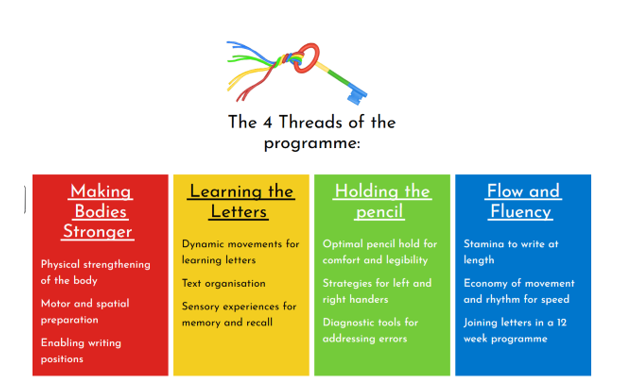
Handwriting is a physical activity that involves movement and recognition skills that need to be learnt and become part of the automatic cognitive skill set of the pupil. To support this, we use the Kinetic Letters programme right through school. Kinetic letters has 4 main threads:
The key principles of the programme are:
- Building physical strength underpins handwriting and concentration. This knowledge informs the working positions that children use for writing and the strengthening targets they work on.
- Pupils are not expected to do anything before they are developmentally ready for it.
- The different components of writing are mastered individually before being used in combination.
- Letters are learnt as movements, not as visual shapes, and movement remains central to developing automaticity in letter formation, flow and fluency.
- Posture is important in developing the correct position for handwriting and so children are taught how to organise their working position and paper position to enable comfortable and fluent writing from the start.
- Once developmentally appropriate, correct pencil hold is taught.
How we teach Kinetic Letters
Teachers are trained in the approach to teaching, which ensures consistency across school.
Kinetic letters starts in nursery and is used throughout the school. Sessions are taught to the whole class with different targets where appropriate and reinforcement may take place in small groups and / or individually. Handwriting is taught in discrete sessions.
In Nursery, there is a strong focus on making the body stronger and fine motor skills. In the environment, a dedicated fine motor area is accessible to the children during child-initiated time.
Within Reception, pupils have a daily Kinetic Letters session where letter formation is practised on the Kinetic Letters whiteboards. Pupils progress to lined paper, when ready. Like Nursery, there is a strong focus on making bodies stronger and there is a dedicated fine motor skills area within the setting.
In Key Stage 1 and Year 3 and 4, pupils have discrete handwriting sessions for 15 minutes per day which focuses on making bodies stronger, fine motor skills and correct sitting positions. The children build upon foundational skills that they develop in EYFS in order to develop their formation and flow. Children will begin learning the skills needed to join in the summer term of Year two. Once in Year 3, children who are ready will join their writing. In Y5 and Y6, handwriting is consolidated, there is a focus on the flow of writing and any gaps in learning are addressed through their daily handwriting sessions. Once children reach this age, the comfort over conformity approach is taken with relation to pencil grip, provided the child has neat, joined, legible writing.
Handwriting audits will take place regularly to ensure that the appropriate adaptations are in place for those children who need it. Children in Reception, Year One and identified children throughout the rest of school will write in handwriting books throughout all subjects in order to develop their letter formation.